
Times of India (Sunday Special), Lucknow, 31 May 2026
Malady Mollifier
Growing number of patients are going for supportive treatment methods like homeopathy along with traditional chemotherapy, with encouraging results
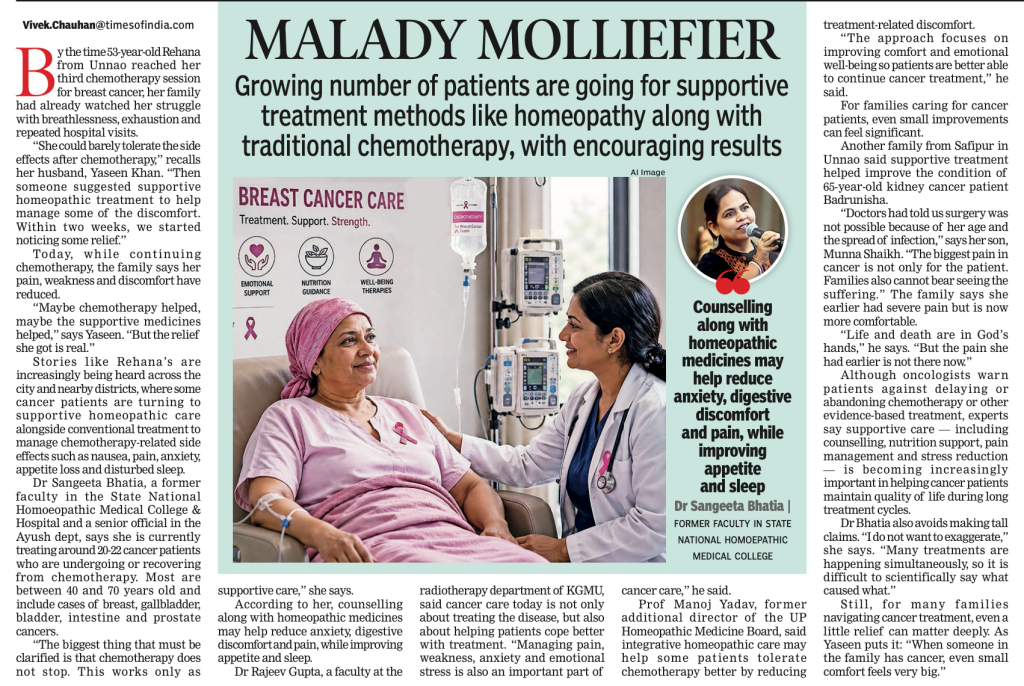
By the time 53-year-old Rehana from Unnao reached her third chemotherapy session for breast cancer, her family had already watched her struggle with breathlessness, exhaustion and repeated hospital visits.
“She could barely tolerate the side effects after chemotherapy,” recalls her husband, Yaseen Khan. “Then someone suggested supportive homeopathic treatment to help manage some of the discomfort. Within two weeks, we started noticing some relief.”
Today, while continuing chemotherapy, the family says her pain, weakness and discomfort have reduced.
“Maybe chemotherapy helped, maybe the supportive medicines helped,” says Yaseen. “But the relief she got is real.”
Stories like Rehana’s are increasingly being heard across the city and nearby districts, where some cancer patients are turning to supportive homeopathic care alongside conventional treatment to manage chemotherapy-related side effects such as nausea, pain, anxiety, appetite loss and disturbed sleep.
Dr Sangita Bhatia, a former faculty in the State National Homoeopathic Medical College & Hospital and a senior official in the Ayush dept, says she is currently treating around 20-22 cancer patients who are undergoing or recovering from chemotherapy. Most are between 40 and 70 years old and include cases of breast, gallbladder, bladder, intestine and prostate cancers.
“Counselling along with homeopathic medicines may help reduce anxiety, digestive discomfort and pain, while improving appetite and sleep.”
“The biggest thing that must be clarified is that chemotherapy does not stop. This works only as supportive care,” she says.
According to her, counselling along with homeopathic medicines may help reduce anxiety, digestive discomfort and pain, while improving appetite and sleep.
Dr Rajeev Gupta, a faculty at the radiotherapy department of KGMU, said cancer care today is not only about treating the disease, but also about helping patients cope better with treatment.
“Managing pain, weakness, anxiety and emotional stress is also an important part of cancer care,” he said.
Prof Manoj Yadav, former additional director of the UP Homeopathic Medicine Board, said integrative homeopathic care may help some patients tolerate chemotherapy better by reducing treatment-related discomfort.
“The approach focuses on improving comfort and emotional well-being so patients are better able to continue cancer treatment,” he said.
For families caring for cancer patients, even small improvements can feel significant.
Another family from Safipur in Unnao said supportive treatment helped improve the condition of 65-year-old kidney cancer patient Badrunisha.
“Doctors had told us surgery was not possible because of her age and the spread of infection,” says her son, Munna Shaikh. “The biggest pain in cancer is not only for the patient. Families also cannot bear seeing the suffering.” The family says she earlier had severe pain but is now more comfortable.
“Life and death are in God’s hands,” he says. “But the pain she had earlier is not there now.”
Although oncologists warn patients against delaying or abandoning chemotherapy or other evidence-based treatment, experts say supportive care — including counselling, nutrition support, pain management and stress reduction — is becoming increasingly important in helping cancer patients maintain quality of life during long treatment cycles.
Dr Bhatia also avoids making tall claims.
“I do not want to exaggerate,” she says. “Many treatments are happening simultaneously, so it is difficult to scientifically say what caused what.”
Still, for many families navigating cancer treatment, even a little relief can matter deeply. As Yaseen puts it: “When someone in the family has cancer, even small comfort feels very big.”
